
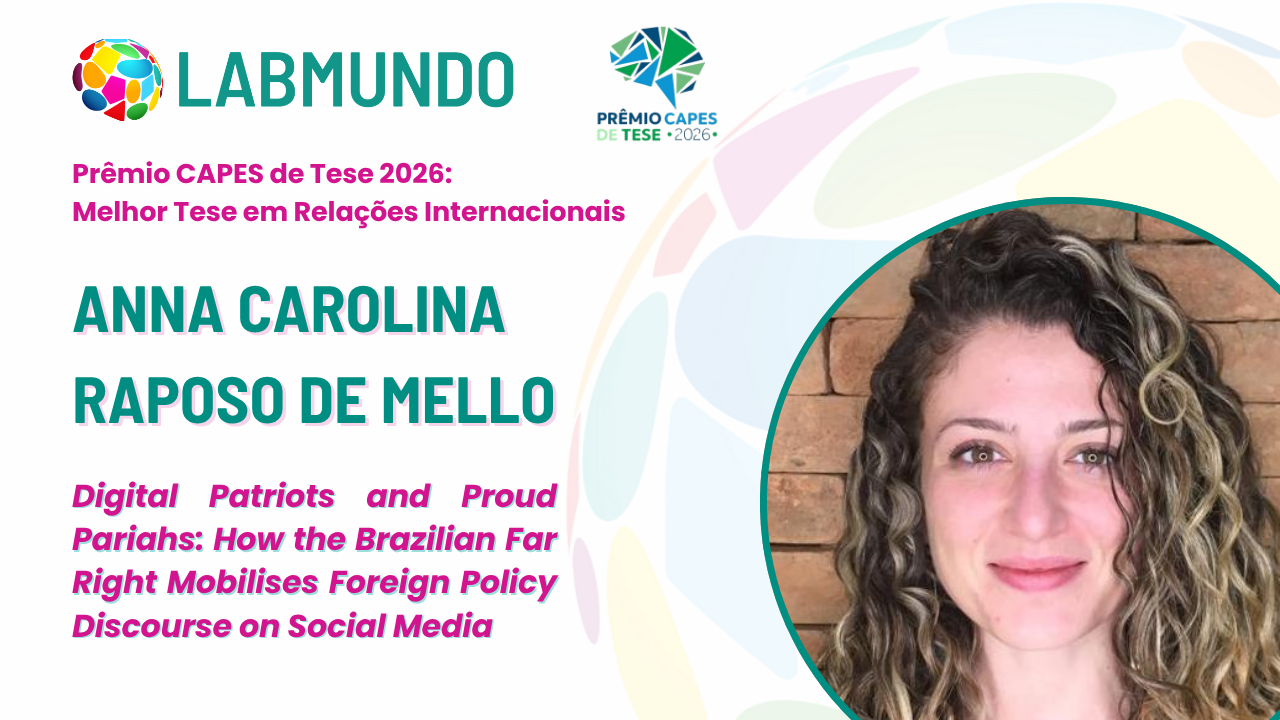
LABUNDO researcher’s thesis wins the 2026 CAPES Prize
- 14/10/2026
The Coordination for the Improvement of Higher Education Personnel (CAPES) has published the list of winning research projects for the 2026 edition of its traditional CAPES Thesis Prize, and it is with great pride that the World Political Analysis Laboratory welcomes the news that our researcher Anna Carolina Raposo de Mello has been awarded for her work as the author of the best academic thesis in the field of Political Science and International Relations. Supervised by Professors Feliciano de Sá Guimarães (IRI-USP), Andreza Aruska (KCL) and Raphael Cunha (KCL), the thesis *Digital Patriots and Proud Pariahs: How the Brazilian Far Right Mobilises Foreign Policy Discourse on Social Media was written by the international relations scholar whilst undertaking a joint PhD at the Institute of International Relations at the University of São Paulo (IRI-USP) and King’s College London (United Kingdom).
Read below for a brief abstract of the award-winning research:
Amid growing authoritarianism and disillusionment with democratic institutions, the far right has established itself as a political force that destabilises democracies around the world. Under a shared reactionary agenda, far-right groups attribute the alleged erosion of cultural principles and moral values to the liberal international order, symbolised by the concept of globalism. Capitalising on the reach of social media, the far right’s discourse on foreign policy promotes nationalism and defends sovereignty by spreading disinformation and conspiracy theories. This thesis examines how the Brazilian far right mobilises foreign policy discourse on social media, with a focus on X, formerly Twitter. Through the analysis of over 12 million tweets between 2019 and 2022, the research investigates how this rhetoric shapes attitudes towards foreign policy and reflects global trends. Using network analysis and discourse analysis, the study identifies key actors, digital communities and discursive elements that drive online debates. The results indicate that the Brazilian far right has instrumentalised foreign policy discourse in a unique way, by mobilising trust-based networks and effective discursive structures, such as conspiracy theories, the delegitimisation of opposing views and the creation of diffuse enemies.
Awarded since 2006, the CAPES Prize recognises the best doctoral theses defended in Brazil in the year preceding the ceremony. The assessment takes into account originality, relevance to scientific, technological, cultural and social development, the methodology employed, the quality of the writing, the organisation of the text, and the quality and quantity of publications arising from the thesis.
Find out more about the award and take a look at the results!
Recent Posts
- LABMUNDO at the 14th UFRJ Defence and Strategic Management Week 19 de October de 2026
- Release event for the Atlas of Brazilian Foreign Policy, at the UFRJ House of Science 14 de October de 2026
- LABUNDO researcher’s thesis wins the 2026 CAPES Prize 14 de October de 2026